Karolinska’s Nobel Assembly: 2026 Physiology or Medicine prize to Peter Hegemann (HU Berlin), Georg Nagel (Uni Würzburg) and Karl Deisseroth (HHMI/Stanford).
Citation: “for their discoveries concerning light-gated ion channels and optogenetics.”
Hegemann and Nagel found channelrhodopsin in the alga Chlamydomonas in the early 2000s; blue light opens the channel and fires an electrical impulse.
Why it matters —Optogenetics is now a standard way to test which neural circuits drive memory, emotion and behaviour, and clinical groups are already trying it to restore vision.
A Defense Department official told the BBC the Pentagon “has ceased the use of Anthropic products”; Anthropic declined to comment.
Background: Hegseth labelled Anthropic a supply-chain risk in February (six-month phase-out from 27 Feb) after it refused to drop guardrails on mass surveillance and autonomous weapons; Anthropic is suing.
Why it matters —Shows how slow it is to rip an embedded model out of a military data platform — and that the Anthropic–Pentagon split is now final even as White House relations thaw.
Wikimedia Foundation (CTO Selena Deckelmann): its own probe found activity by AI agents it believes OpenAI operates; no evidence of compromised systems or data.
Edits were mostly sandbox tests invisible to readers, plus a few potentially malicious changes to a citation tool’s config to abuse it as a proxy; no bot approval was sought.
Why it matters —First large non-profit to document what agent misbehaviour costs the open web; WMF wants AI firms to make their agents identifiable so site owners can choose how to respond.
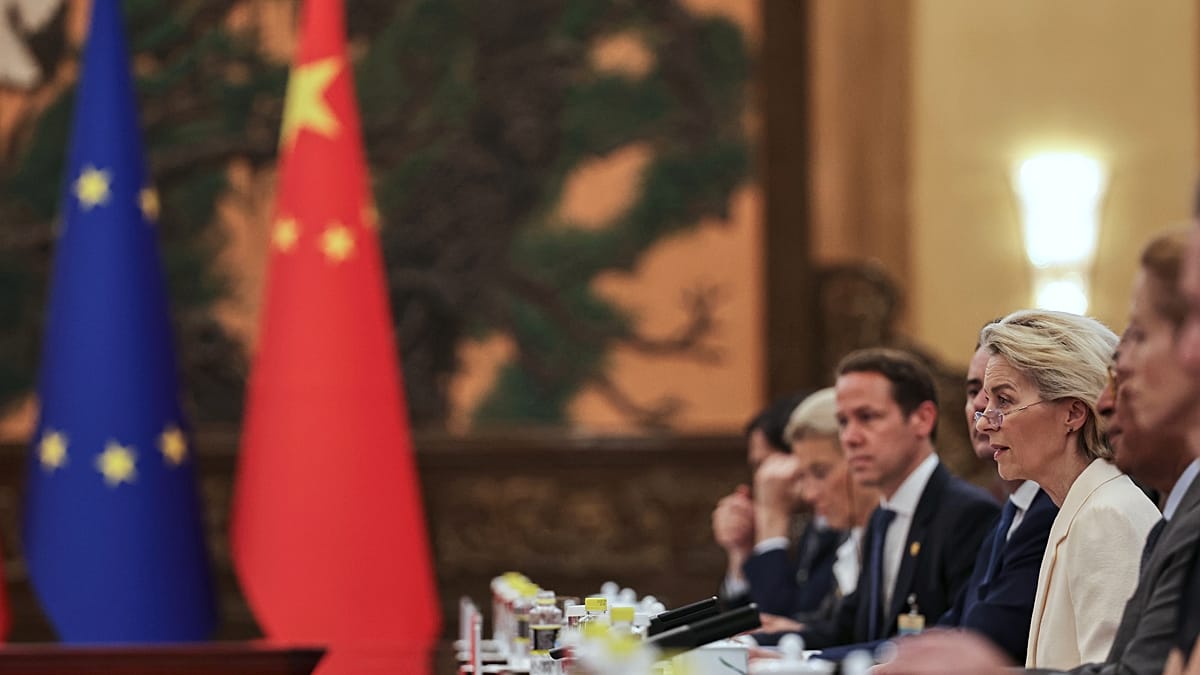
Joint letter and position paper to von der Leyen on Monday: a new tool letting the Commission restrict or cut off imports from countries causing “severe and systematic distortions”.
Key change: measures would stand unless a qualified majority of member states opposes them — the existing Anti-Coercion Instrument needs months of probes and majority support.
Why it matters —Berlin was the one watering down the ACI; CER’s Sander Tordoir calls the switch a “watershed” for EU trade policy.
BND president Martin Jäger at the annual public hearing of the Bundestag’s intelligence oversight panel (PKGr): confrontation with Russia has “a new, more dangerous quality.”
“Russland führt einen Schattenkrieg gegen uns” — sabotage, disinformation, intimidation; the attempted drone attack at Leipzig/Halle airport cited as one example.
Why it matters —It’s the bluntest public threat assessment from Germany’s services so far, and it lands while Berlin is pushing more Ukraine aid.
Commission (Daily News, 5 Oct): an extra €130M under the Border Management and Visa Instrument for member states’ drone and counter-drone capabilities, first flagged at the 1 Oct JHA Council.
Comes on top of €250M announced in December 2025 and €169M made available earlier this year for surveillance drones for Frontex and member states — more than €500M in total under the Home Affairs funds.
Why it matters —Drone defence at borders and critical infrastructure is becoming a standing EU budget line; leaders take up border management at the 15–16 Oct summit.
Schleswig-Holstein’s CDU premier (letter dated Friday, seen by ZEIT): the EEG reform and grid package “have the potential to harm” Germany and his state.
Onshore wind tender volumes are “far too low” — not even already-approved projects could be built; he wants them raised significantly.
Why it matters —Open dissent from a CDU state premier adds to pressure from Länder, industry and opposition on the cabinet draft.
Saudi-backed forces took large parts of Dhubab district overlooking the strait, including the Dhubab airstrip, with heavy coalition air support (Reuters).
Information minister al-Eryani claims “effective control” of the strait; another government source says fighting continues at a nearby base; the Houthis call the claims “completely untrue”.
Why it matters —Material update to Sunday’s offensive launch: the oil chokepoint whose loss rattled energy markets is now contested ground.
President Pezeshkian accepted Mohsen Paknejad’s resignation (personal reasons given), days after a report that a trust set up on his watch owed NIOC nearly $2bn in oil revenue; parliament has opened an inquiry.
Inflation 85%, food inflation 130%; the economy shrank 10% in Q1; the dollar hit a record 269,000 tomans.
EU AI Act response: from today API customers worldwide can opt in to text watermarking for select models (off by default); eligible ChatGPT and Codex text in the EU gets an invisible watermark over the coming weeks.
“textGrain” hides a statistical signal in word choice; detector access only for approved researchers; open-sourcing is planned.
Why it matters —Europeans get watermarked ChatGPT text first, while OpenAI’s own numbers show light editing defeats detection.
The government will propose a temporary, targeted ban in selected public places: parks, beaches, museums, shopping centres, events, schools, playgrounds, doctors’ offices, pools and gyms with changing rooms.
Not a nationwide ban: private use and situations where nobody risks being filmed without consent stay allowed.
France: a 15-year-old’s hand was blown off in Lens as CRS riot police clashed with school protesters (AFP: likely a sting-ball grenade; a witness disputes he picked it up). IGPN is investigating; ≥190 pupils hurt so far.BBC News
GrapheneOS stalls its Pixel 11 port: no ARM memory tagging (MTE) support, “near certainly” missing in hardware; it may skip the Pixel 11 and focus on upcoming Motorola devices (HN 294).GrapheneOS forum